That "AUX HEAT" light just lit up on your thermostat — and your first instinct is to wonder if something broke. After manufacturing HVAC filtration products for over a decade and helping more than two million households navigate their heating systems, we can tell you this: what does auxiliary heat mean is one of the most searched and least understood questions about a home heating system, and first-time homeowners encounter it more than anyone.
Here's what you need to know right away. Auxiliary heat is a backup heating source built into heat pump systems. It activates automatically when outdoor temperatures fall too low for your heat pump to keep up on its own — and in our experience, the homeowners who understand this distinction upfront are the ones who avoid unnecessary service calls and inflated energy bills.
This guide covers exactly how auxiliary heat works, when it should run, when it shouldn't, and what to do if something actually is wrong — so you can protect your home, your HVAC system, and your wallet from day one.
TL;DR Quick Answers
What Does Auxiliary Heat Mean?
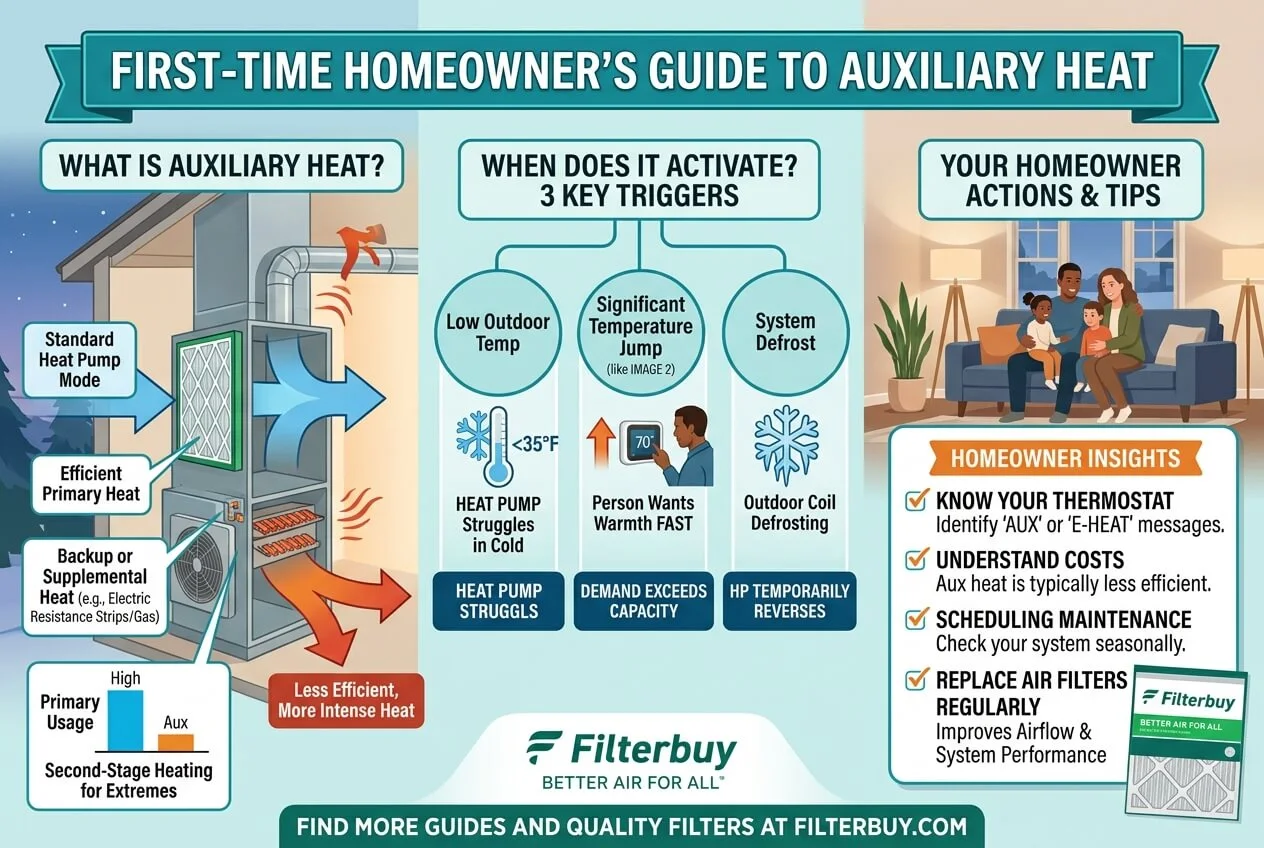
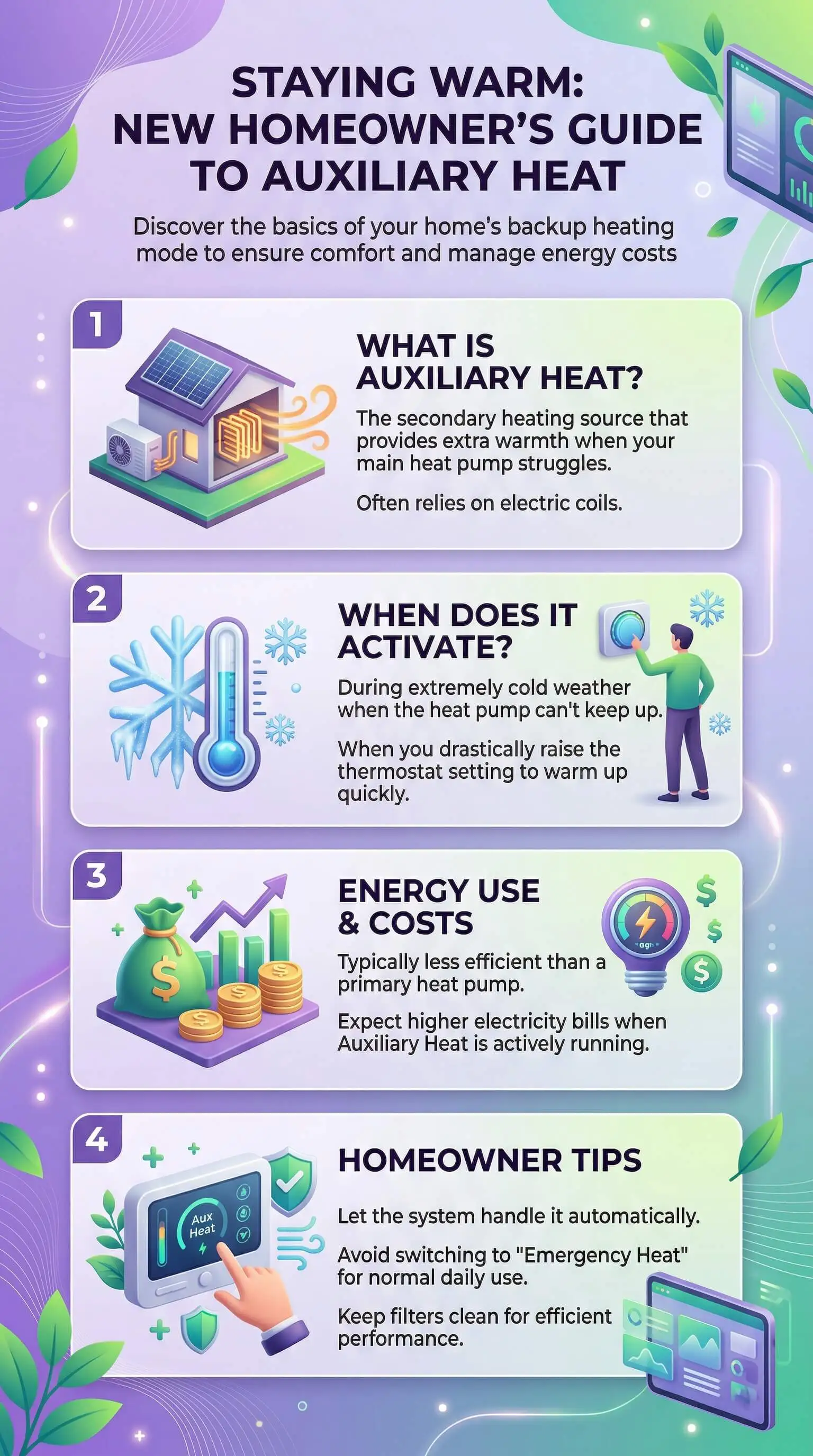
Auxiliary heat is the backup heating system built into heat pump systems. It activates automatically when outdoor temperatures drop too low for the heat pump to maintain your set temperature on its own — typically below 35°F to 40°F.
Key facts:
"AUX HEAT" on your thermostat is not a warning — it is your system working as designed
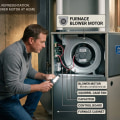
Auxiliary heat uses electric resistance heating strips inside your air handler
It runs alongside your heat pump, not instead of it
It shuts off automatically once your heat pump can handle the demand on its own
It is not the same as emergency heat, which is a manual setting used only when your heat pump has failed
After serving over two million households, the single most valuable thing a first-time homeowner can know about auxiliary heat is this: occasional activation is normal, continuous activation is not. A clean filter, gradual thermostat adjustments, and annual maintenance are the three habits that keep auxiliary heat running briefly — exactly as it was designed to.
Top Takeaways
AUX HEAT is a feature, not a failure. It activates automatically when your heat pump needs support. If it runs during a cold snap or morning warm-up, your system is working exactly as designed.
Auxiliary heat and emergency heat are not the same thing. Auxiliary heat works alongside your heat pump. Emergency heat bypasses it entirely — and costs significantly more to run. Only use emergency heat when a technician advises it.
A clogged filter is one of the most preventable causes of auxiliary heat overuse. Restricted airflow forces your heat pump to underperform and auxiliary heat to compensate. Replace your filter every 30 to 90 days.
Auxiliary heat running constantly is the warning sign — not auxiliary heat running at all. Normal: activates during freezing temps or large thermostat adjustments. Not normal: runs for hours on a mild day, won't shut off, or your energy bill spikes without explanation.
Four habits prevent most auxiliary heat problems:
Learn how your heat pump and auxiliary system work together
Make gradual thermostat adjustments — avoid large temperature jumps
Replace your air filter every 30 to 90 days
Schedule annual heat pump maintenance before heating season
What Is Auxiliary Heat?
Auxiliary heat — often labeled "AUX HEAT" on your thermostat — is a secondary heating source built directly into heat pump systems. It works alongside your heat pump, not instead of it. When outdoor temperatures fall to a point where your heat pump alone can't maintain your set temperature efficiently, auxiliary heat activates automatically to fill the gap.
In most homes, auxiliary heat is provided by electric resistance heating strips installed inside the air handler. Think of them like a large version of a space heater coil — effective, but more energy-intensive than your heat pump operating on its own.
The key distinction first-time homeowners need to understand: auxiliary heat is a designed feature, not a warning sign.
How Auxiliary Heat Differs from Emergency Heat
These two terms are frequently confused, and in our experience working with homeowners across the country, that confusion is one of the most common reasons people call for service when nothing is actually wrong.
Here's the difference:
Auxiliary heat activates automatically. Your system manages it without any input from you.
Emergency heat is a manual setting you switch on yourself — typically only used when your heat pump has failed entirely and needs repair.
Running your system on emergency heat when the heat pump is functioning normally forces your system to rely entirely on the energy-intensive heating strips. That can add significantly to your monthly utility bill. Only use emergency heat when a technician advises it or when your heat pump is confirmed inoperable, and use a MERV 8 filter to help maintain steady airflow and support more efficient system performance during normal operation.
When Should Auxiliary Heat Turn On?
Auxiliary heat is designed to engage under specific, predictable conditions. Knowing what those are helps you recognize normal operation versus a potential problem.
Your auxiliary heat should activate when:
Outdoor temperatures drop below approximately 35°F to 40°F, which is the typical range where heat pump efficiency declines
Your thermostat is set more than 2°F to 3°F above the current indoor temperature, triggering a "large call for heat"
Your system is running a defrost cycle, during which the heat pump temporarily stops heating — auxiliary heat keeps your home warm during that brief window
After more than a decade of helping homeowners understand their HVAC systems, we've found that cold snaps and morning warm-up cycles account for the vast majority of auxiliary heat activations that concern first-time homeowners. In most cases, the system is doing exactly what it was designed to do, helping homeowners make more informed HVAC repair decisions and avoid unnecessary service calls.
When Auxiliary Heat Is a Problem
Auxiliary heat running occasionally is normal. Auxiliary heat running constantly is not. There are several situations where the AUX HEAT indicator is a signal worth investigating.
Watch for these warning signs:
AUX HEAT stays on for hours during mild weather (above 40°F) — this often points to a heat pump that isn't operating efficiently
Energy bills spike sharply without a corresponding drop in outdoor temperature — prolonged auxiliary heat use is one of the leading causes of unexpected heating cost increases
The system struggles to reach your set temperature even with auxiliary heat running — this can indicate low refrigerant, a dirty filter, or a failing component
AUX HEAT activates with only a 1°F difference between your set temperature and current indoor temperature — normal auxiliary activation requires a larger temperature gap
A dirty or clogged air filter is one of the most overlooked contributors to auxiliary heat running longer than it should. When airflow is restricted, your heat pump has to work harder and longer to move conditioned air through your home — and auxiliary heat picks up the slack. Checking and replacing your filter regularly with one of the best air filters is one of the simplest ways to keep your system running at peak efficiency.
How to Manage Auxiliary Heat as a First-Time Homeowner
You don't need to intervene every time AUX HEAT appears on your thermostat — but there are a few proactive habits that will help you stay in control of your heating system and your energy costs.
Set your thermostat conservatively. Large, sudden temperature increases (raising the set point by 5°F or more at once) trigger more auxiliary heat use. Gradual adjustments keep your heat pump doing most of the work.
Use a programmable or smart thermostat. Scheduling gradual temperature increases overnight or before you wake up reduces the demand spikes that activate auxiliary heat unnecessarily.
Replace your air filter on schedule. A clean filter ensures your heat pump moves air efficiently — reducing the workload that forces auxiliary heat to compensate. For most homes, that means replacing your filter every 30 to 90 days depending on filter type and household conditions.
Schedule annual heat pump maintenance. A professional inspection each fall ensures refrigerant levels, coil condition, and electrical components are in good shape before the heating season begins.
Know your baseline energy bill. Tracking your utility costs month over month is one of the most practical ways to detect when your system is working harder — and spending more — than it should be.
Does Your Home Have Auxiliary Heat?
Not every home uses a heat pump, which means not every home has auxiliary heat. Auxiliary heat is specific to heat pump systems — it is not a feature found in gas furnaces or boilers.
If you're unsure what type of heating system your home uses, check your thermostat settings. If you see options for "Heat Pump," "AUX HEAT," or "Emergency Heat," you have a heat pump system with auxiliary heating capability. If your system runs on natural gas or propane with a furnace, auxiliary heat does not apply to your home.
"One pattern we see consistently across the homes we serve: first-time homeowners who panic at the sight of 'AUX HEAT' and switch their system to emergency heat manually end up paying far more than they need to. Auxiliary heat is a safeguard your system is built with — it's not a distress signal. What we tell every new homeowner is this: if AUX HEAT is running during a cold snap or a morning warm-up cycle, your system is working exactly as designed. If it's running on a 45-degree afternoon with your thermostat set to 68, that's when you pick up the phone. Knowing the difference is the single most valuable thing a first-time homeowner can learn about their heating system — and it starts with a good filter and a basic understanding of how heat pumps actually work."
Essential Resources
Knowing what auxiliary heat is helps you protect your system, manage energy costs, and avoid unnecessary service calls. We've pulled together the resources our team trusts most — so you can get the right answers quickly and make informed decisions about your home.
The Government's Plain-English Guide to How Heat Pumps Actually Work — U.S. Department of Energy
This is the resource we point homeowners to first. The Department of Energy breaks down how heat pumps work, where auxiliary heat fits in, and why efficient heat pump operation can reduce your electricity use significantly compared to resistance heating alone. No brand bias — just the facts.
https://www.energy.gov/energysaver/heat-pump-systems
What the EPA Wants You to Know About Heat Pump Efficiency and Auxiliary Backup — ENERGY STAR
ENERGY STAR's guidance covers cold-climate certification standards, how backup heating systems pair with your heat pump, and practical tips for keeping your system running efficiently all winter. A useful reference if you're trying to minimize how often auxiliary heat kicks in.
https://www.energystar.gov/products/air_source_heat_pumps
Why "AUX HEAT" Shows Up on Your Thermostat — Trane
Trane walks through what the AUX HEAT indicator means, when it's completely normal, and when it's a sign something needs attention. It's one of the clearer manufacturer explanations available — written for homeowners, not technicians.
https://www.trane.com/residential/en/resources/blog/heat-pump-auxiliary-heat/
How Auxiliary Heat Affects Your Monthly Energy Bill — Carrier
If your energy bill jumped this winter and you're not sure why, this resource explains the connection between auxiliary heat overuse and higher electricity costs. Carrier covers what triggers auxiliary heat, how to optimize your thermostat settings, and what overreliance on backup heat does to your system long-term.
https://www.carrier.com/residential/en/us/homeowner-resources/hvac-glossary/what-is-auxiliary-heat/
All-Electric vs. Dual-Fuel Systems: How AUX Heat Behaves Differently — American Standard
Not all auxiliary heat works the same way. This resource explains the difference between electric resistance backup and gas-paired dual-fuel configurations — and why that distinction matters when you see AUX on your thermostat. Practical tips for reducing auxiliary heat dependence are included for both system types.
https://www.americanstandardair.com/resources/blog/what-is-aux-heat/
How to Use a Smart Thermostat to Keep Auxiliary Heat Under Control — Bryant
This guide is useful for homeowners who want more control over when and how often auxiliary heat runs. Bryant covers balance point settings, warning signs that your system is over-relying on backup heat, and how programmable thermostat schedules can reduce unnecessary activation.
https://www.bryant.com/en/us/about-bryant/glossary/what-is-auxiliary-heat/
What to Do When AUX HEAT Won't Turn Off — HVAC.com
When auxiliary heat stays on longer than it should, most homeowners aren't sure where to start. This resource walks through the most common causes — dirty filters, defrost cycle issues, thermostat errors — and tells you clearly what you can check yourself before calling a technician.
https://www.hvac.com/expert-advice/what-does-auxiliary-heat-mean-on-my-thermostat/
These essential resources explain how auxiliary heat works, when it is normal, how it affects efficiency and energy costs, and how understanding it can lead to more confident, informed decisions about top HVAC system replacement for better comfort and long-term performance.
Supporting Statistics
Most homeowners don't realize that the moment auxiliary heat takes over, they've crossed into the most expensive heating mode their system offers. Federal energy data puts that cost in real terms.
Space Heating Accounts for More of Your Energy Bill Than Anything Else in Your Home
After more than a decade working with homeowners on their HVAC systems, we've seen how surprised people are when they discover where their energy dollars actually go.
Space heating accounts for 42% of total residential energy consumption — more than any other home end use
The average U.S. household spent $519 on space heating in 2020
For heat pump homes, that number is directly tied to how often auxiliary heat is doing the heavy lifting
Source: U.S. Energy Information Administration — Residential Energy Consumption Survey (RECS) https://www.eia.gov/pressroom/releases/press535.php
Auxiliary Heat Strips Use Up to 75% More Electricity Than Your Heat Pump Running Normally
This is the stat we come back to most often when helping first-time homeowners understand why auxiliary heat overuse matters.
The U.S. Department of Energy confirms heat pumps use up to 75% less electricity than electric resistance heating — the same technology powering your auxiliary heat strips
Every hour in auxiliary mode costs significantly more than heat pump mode
Homeowners who understand this early take thermostat habits and filter maintenance seriously — the ones who don't are usually the ones calling us confused about a high January energy bill
Source: U.S. Department of Energy — Heat Pump Systems https://www.energy.gov/energysaver/heat-pump-systems
One of the Cheapest Ways to Control Auxiliary Heat Costs Is Also the Most Overlooked
Serving over two million households has taught us that the gap between an efficient system and one over-relying on auxiliary heat is often nothing more than a clogged filter.
ENERGY STAR confirms a dirty filter slows airflow and forces your system to work harder — wasting energy and accelerating wear
For heat pump systems, restricted airflow prevents the heat pump from doing its job — triggering auxiliary heat to compensate for a problem a filter replacement could have prevented
It's one of the most consistent patterns we observe across the homes we serve, and it's entirely avoidable
Source: ENERGY STAR — Heat & Cool Efficiently https://www.energystar.gov/saveathome/heating-cooling
A Properly Managed Heat Pump System Can Save Most Households Hundreds of Dollars Every Year
The savings from efficient heat pump operation are documented — not theoretical.
Peer-reviewed research from two national laboratories found that for over 90% of U.S. households assessed, the right heat pump reduces energy bills meaningfully
Average savings: $300 per year in moderate climates — up to $1,500 annually for homes previously using propane or electric resistance heating
In our experience, the homeowners who capture those savings treat auxiliary heat as the backup it was designed to be — not a substitute for a well-maintained heat pump
Source: U.S. Department of Energy — For Most Americans, A Heat Pump Can Lower Bills Right Now https://www.energy.gov/policy/articles/most-americans-heat-pump-can-lower-bills-right-now
Final Thoughts
Auxiliary heat quietly separates informed homeowners from reactive ones. Most people encounter it for the first time on a cold morning, see "AUX HEAT" on their thermostat, and assume something is wrong. In almost every case, nothing is.
After more than a decade of manufacturing HVAC filtration products and serving over two million households, here's our honest take: first-time homeowners who struggle with auxiliary heat aren't struggling because their systems are broken. They're struggling because no one explained how the system was designed to work.
The most common ways homeowners inadvertently work against their own system:
Making large thermostat jumps that trigger unnecessary auxiliary heat activation
Neglecting filter changes that restrict airflow and force the heat pump to underperform
Switching to emergency heat out of panic — driving energy bills up for no reason
What we've also observed consistently: the homes where auxiliary heat runs the longest aren't always the coldest homes. They're the homes with the most restricted airflow — clogged filters, dirty coils, undersized returns — that force auxiliary heat to compensate for a problem that's almost always preventable.
Our opinion is straightforward. Auxiliary heat isn't a problem to solve — it's a system to understand. The four habits that prevent the majority of auxiliary heat issues we see every winter:
Learn how your heat pump and auxiliary system work together
Change your filter on schedule — every 30 to 90 days depending on your household
Make gradual thermostat adjustments instead of large temperature jumps
Schedule annual heat pump maintenance before heating season begins
Homeowners who follow these steps protect their equipment, control their energy costs, and avoid unnecessary service calls. The ones who don't end up chasing symptoms instead of addressing causes.
FAQ on What Does Auxiliary Heat Mean
Q: What does auxiliary heat mean on my thermostat?
A: It means your heat pump's backup heating system has kicked in. In most cases, that's exactly what's supposed to happen.
Auxiliary heat uses electric resistance heating strips inside your air handler
It activates when outdoor temps drop too low for your heat pump — typically below 35°F to 40°F
After serving over two million households, the most important thing we tell first-time homeowners: "AUX HEAT" is information, not an alarm
Q: Is it bad if auxiliary heat comes on?
A: Not on its own — no. Occasional activation is completely normal. It becomes a concern when:
Auxiliary heat runs continuously during mild weather
It won't shut off after temperatures rise
Your energy bill spikes without a clear explanation
Occasional activation means your system is doing its job. Constant activation means something is working against it.
Q: What is the difference between auxiliary heat and emergency heat?
A: This is the distinction that saves homeowners the most money once they understand it.
Auxiliary heat — activates automatically alongside your heat pump. Both run together.
Emergency heat — shuts your heat pump off entirely and relies solely on expensive electric resistance heating
Unnecessary switches to emergency heat are one of the most avoidable causes of high winter energy bills. Use emergency heat only when:
Your heat pump has failed completely
A technician has confirmed it is inoperable
Q: Why does my auxiliary heat keep running too long?
A: A dirty air filter is the first thing we check — and more often than not, it's the culprit. Here's how to troubleshoot:
Check your filter first. Restricted airflow forces auxiliary heat to compensate for a problem a simple filter replacement could prevent
Check refrigerant levels. Low refrigerant reduces heat pump efficiency and increases auxiliary heat dependence
Check your thermostat. A malfunctioning thermostat can trigger auxiliary heat unnecessarily
Call a professional. If steps 1 through 3 don't resolve it, a system inspection is needed
Start simple, then escalate.
Q: Does auxiliary heat use more electricity than a heat pump?
A: Significantly more. The U.S. Department of Energy confirms heat pumps use up to 75% less electricity than electric resistance heating — the same technology auxiliary heat strips rely on.
Homeowners who see a sharp January energy bill and can't explain it are almost always dealing with a system that spent too many hours in auxiliary mode
Three habits keep auxiliary heat in its proper role as a brief backup — not a primary heating source:
Replace your air filter every 30 to 90 days
Make gradual thermostat adjustments — avoid large temperature jumps
Schedule annual heat pump maintenance before heating season begins
Ready to Take Control of Your Home's Heating System?
Now that you understand what auxiliary heat means and how it works, the next step is making sure your heat pump and air filtration system are set up to keep it running efficiently. Explore Filterbuy's full line of air filters — designed to protect your HVAC system, reduce auxiliary heat overuse, and keep your home comfortable all winter long.