TL;DR Quick Answers
top HVAC system replacement near Clermont FL
A top HVAC system replacement near Clermont FL delivers three things: an on-site Manual J load calculation before any quote, a verified Florida DBPR license confirmed at MyFloridaLicense.com, and a written line-item breakdown of equipment, labor, permits, and duct work. We bring all three to every Clermont assessment.
Top Takeaways
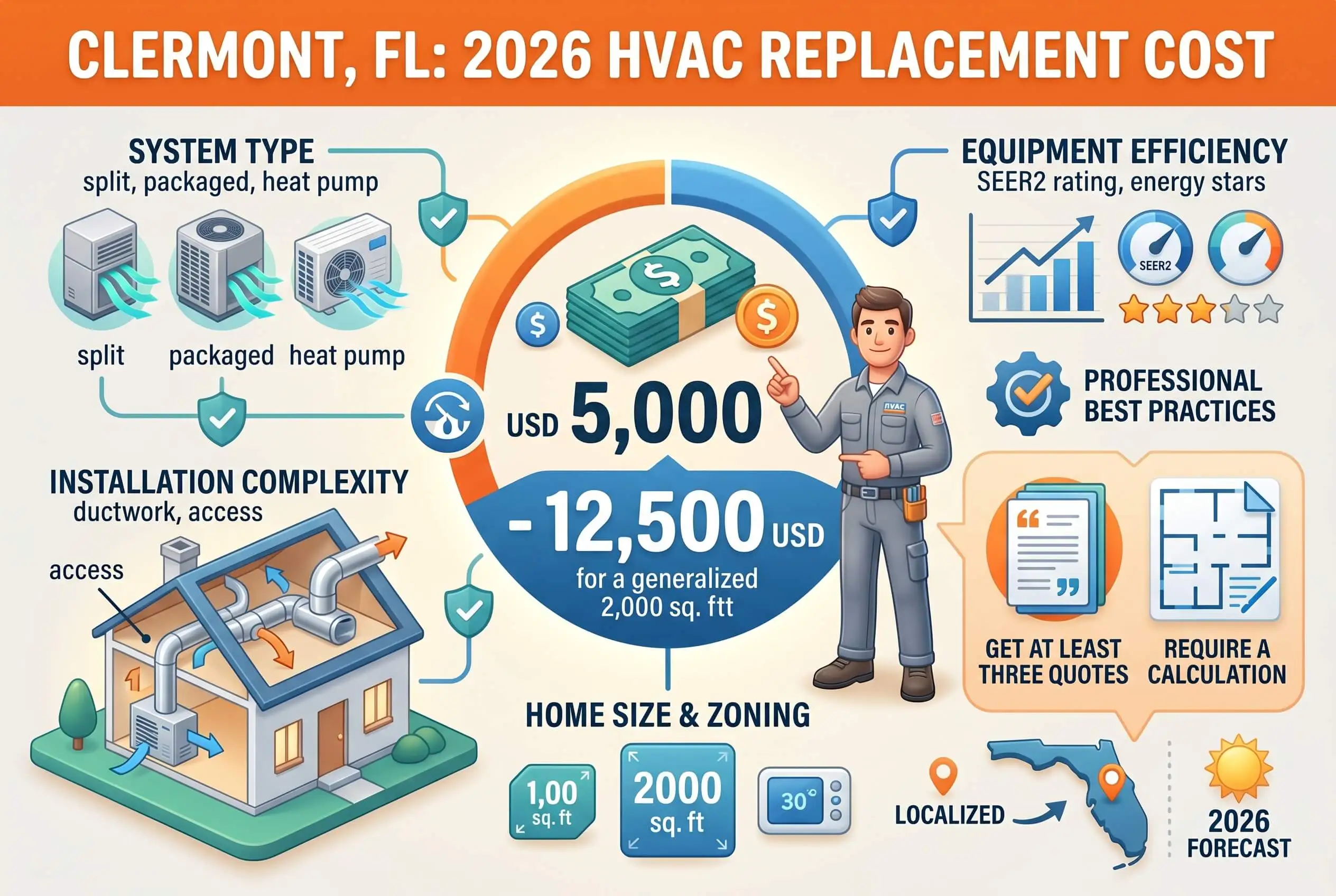
Most Clermont HVAC replacement quotes bundle seven or eight line items behind one total. Labor, permits, and duct rework drive the spread between competing quotes more than equipment brand.
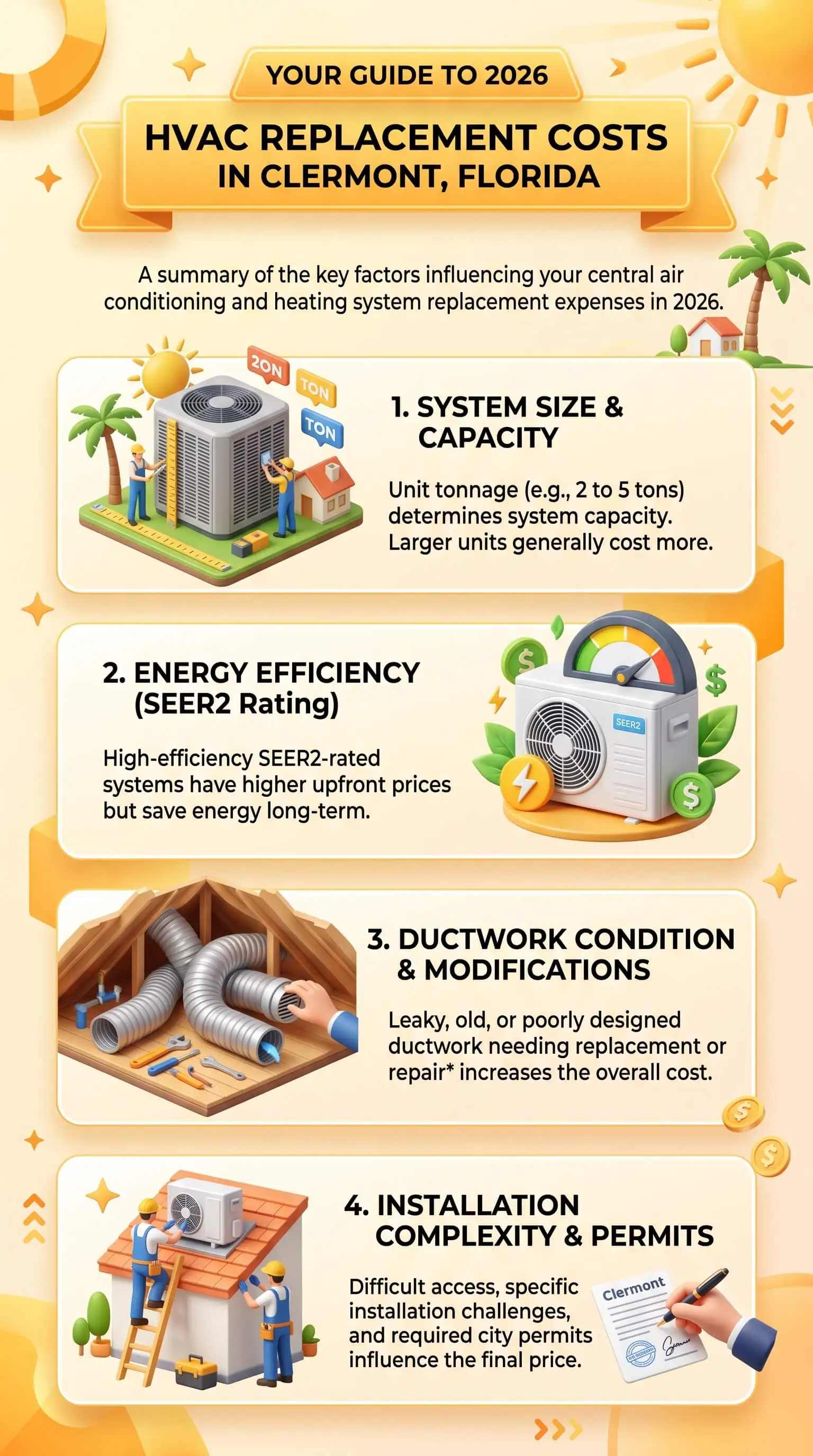
Four factors move the price most: system size from a Manual J load calculation, SEER2 efficiency tier, existing ductwork condition, and add-ons like heat pump versus straight-cool, smart thermostats, and air-quality equipment.
Clermont's housing stock skews newer than most Central Florida cities, with a median construction year of 2006. That generally means less duct rework on a replacement and a lower total quote.
Duke Energy Florida offers HVAC replacement rebates that require a free Home Energy Check before install begins. Confirm current 2026 rebate amounts and federal 25C tax credit eligibility with the source directly before building either into your budget.
Repair-versus-replace test: multiply the system's age by the proposed repair cost. If the result clears 5,000, replacement is usually the better long-term call.
Verify any Clermont HVAC contractor's Florida DBPR license at MyFloridaLicense.com before signing. It takes two minutes and rules out the bottom tier of providers right away.
What's Actually in the Quote
A typical Clermont HVAC replacement quote bundles seven or eight line items behind one total. The condenser and air handler make up the largest single share, and everything else adds up faster than most homeowners expect: labor for a two-technician crew over a one- or two-day install, Lake County permitting and final inspection, refrigerant and line-set work, electrical disconnect and any panel updates the inspector flags, ductwork modifications when the existing layout doesn't match the new equipment's airflow, a new thermostat, and post-install commissioning. Two quotes can come back hundreds of dollars apart for what looks like the same equipment. The line items that don't carry brand names usually explain the gap. Labor, permits, and duct rework do most of the moving.
The Four Factors That Move the Price the Most
1. System Size
A proper sizing job runs through a Manual J load calculation, which accounts for square footage, insulation, window area, orientation, and attic temperature. That last factor matters more in Clermont than in most U.S. markets, where attic conditions don't drive sizing the way they do here. Central Florida attics regularly hit 130 to 140 degrees on summer afternoons, which pushes the right-sized system slightly larger than the same square footage would call for in a milder climate. Undersizing leads to systems that run nonstop and never reach setpoint. Oversizing brings the opposite problem: short cycling, poor humidity control, and a compressor that wears out years early. We've seen both failure modes far more often than we'd like in homes a previous contractor sized off square footage alone.
2. SEER2 Efficiency Tier
The federal minimum for new central air conditioners in our southern region is 14.3 SEER2. Mid-tier two-stage equipment lands in the 16 to 18 SEER2 band, and high-efficiency variable-speed systems run 18+ SEER2 with the best humidity control of the three. Humidity control matters here. Our cooling systems run a long shoulder season into November, and the right tier on a Clermont home is rarely just about peak summer. Choosing the right efficiency level also plays an important role in maximizing HVAC system lifespan by reducing strain, improving airflow consistency, and supporting more stable long-term performance in Florida’s demanding climate. Each step up the efficiency ladder adds equipment cost and typically extends warranty length. Whether the higher tier pays back depends on your runtime hours and your electricity rate, both of which are easy to pull off a recent Duke Energy bill.
3. Existing Ductwork Condition
This is where Clermont's housing stock works in your favor. The median home construction year in Clermont is 2006: roughly 42 percent of the city's homes went up between 2000 and 2009 and another 28 percent between 2010 and 2019. Builders working to post-2000 codes generally ran reasonably modern duct in conditioned attic space, so the rework line item on a Clermont replacement quote is often minimal. The exceptions we see most often: pre-2000 homes near the older downtown grid, additions that someone hung off an existing system without recalculating airflow, and 1990s flex duct that has sagged or compressed over the past two decades. When your contractor wants to cut a new register or reroute a trunk line, ask them to show you the static pressure reading they took before quoting. A real contractor will have one ready.
4. Add-Ons and Equipment Type
Heat pump versus straight-cool changes the equipment cost by a meaningful amount, and a heat pump generally makes more sense in Lake County than electric strip backup heat. Smart thermostats, indoor air quality equipment, surge protection, and UV lights are the most common add-ons. None of them are required to get the system running. The right one or two, sized for your home, can change the long-term operating cost more than another half-step of SEER2 will. For homes in our Clermont service area, we walk through these options on-site so you're not paying for equipment you won't actually use. You can request a free in-home assessment through our Clermont HVAC system replacement page.
Rebates, Tax Credits, and Financing in 2026
Duke Energy Florida runs a residential Home Energy Improvement program with rebates on qualifying HVAC and heat pump replacements. One requirement homeowners often miss: the free Home Energy Check has to happen before installation begins, not after. Current program details, eligibility requirements, and rebate amounts live on the Duke Energy HVAC Replacement rebate page. On the federal side, the Energy Efficient Home Improvement Credit (Section 25C) has historically offered a percentage credit on qualifying high-efficiency equipment. For homeowners considering a professional HVAC replacement, those incentives can make upgrading to a more energy-efficient system even more attractive over the long term. Current 2026 eligibility, caps, and the post-OBBBA placed-in-service rules are still in flux, so check the IRS guidance directly before counting on the credit in your budget. Local financing through HVAC contractors and the manufacturer's own promotional periods, typically spring and early fall, usually opens the longest deferred-interest windows.
When Replacement Beats Repair
We use a simple test when a Clermont homeowner asks us to weigh repair against replacement: multiply the age of the system in years by the cost of the proposed repair. If the result clears 5,000, replacement is usually the better long-term call. Past 12 years on a Central Florida system that's been carrying a cooling load for ten months out of the year, the math almost always tips toward replacement. That holds even when a single repair would technically get the unit running again, because the next failure is usually closer than the first one suggested. Repeat repair frequency is the other tell. If you've called for service twice in the last 18 months, the third call usually isn't far behind.
“Most of the homes we walk in Clermont went up between 2000 and 2015, and the ductwork is generally in decent shape. So when a quote comes back with a heavy duct rework line item on a 2008 build, that's the first thing I push back on. What I look for first is the static pressure reading and the Manual J. If the contractor has neither, fix the diagnosis before negotiating the price.”
7 Essential Resources
We checked every link below for current availability before writing this section. Together they cover the technical, regulatory, financial, and indoor-air-quality angles of a Clermont HVAC replacement decision.
Heating, ventilation, and air conditioning — Wikipedia. A general technical reference for the components, terminology, and history of HVAC systems.
ENERGY STAR — Heat & Cool Efficiently. The EPA's homeowner guide to HVAC efficiency, including filter changes, duct sealing, and equipment-replacement guidance.
U.S. Department of Energy — Space Heating and Cooling Products and Services. The DOE's central index for ENERGY STAR-qualified equipment categories and contractor lookups.
Florida DBPR — MyFloridaLicense.com. Verify any HVAC contractor's active state license before signing a contract. Florida requires a Class A or Class B contractor license for residential HVAC work.
Duke Energy Florida — HVAC Replacement Rebate. The current rebate program for Duke Energy Florida residential customers, including the Home Energy Check prerequisite.
EPA — Indoor Air Quality (IAQ). The EPA's homeowner-facing IAQ resource, useful when deciding whether to layer in an air purifier or upgraded filtration with a system replacement.
Filterbuy HVAC Solutions — Clermont, FL HVAC System Replacement. The local service area page for HVAC system replacement in Clermont. Free in-home assessment available.
3 Supporting Statistics
All three statistics below come straight from primary U.S. government data, not aggregators or secondhand summaries.
Heating and cooling account for nearly half of the energy used in a typical U.S. home, which makes equipment efficiency one of the largest single levers a homeowner has on monthly utility cost. Source: ENERGY STAR (EPA), Heat & Cool Efficiently.
Sealing and insulating ducts can improve a system's efficiency by as much as 20 percent. That's a meaningful number for late-1990s Clermont homes, where flex ducts often sags in the attic over time. Source: ENERGY STAR (EPA), Heat & Cool Efficiently.
Improper installation can reduce a new HVAC system's efficiency by up to 30 percent, which drives up monthly bills and shortens the equipment's service life. Contractor quality is the variable many homeowners underweight when comparing quotes. Source: ENERGY STAR (EPA), Heat & Cool Efficiently.
These government-backed statistics show why investing in a top HVAC system replacement can make such a major difference for Clermont homeowners by improving energy efficiency, lowering monthly utility costs, enhancing duct performance, and ensuring the system is installed correctly for stronger long-term comfort and reliability.
Final Thoughts and Opinion
An HVAC replacement in Clermont is one of the larger discretionary investments most homeowners make in a given decade, and the spread between a fair quote and a padded one is wider than it should be. Clermont homeowners have a few advantages working in their favor that other Central Florida cities don't share: the housing stock is newer, most ductwork is in serviceable condition, and Duke Energy's Lake County rebate program is straightforward to enroll in when you start with the free Home Energy Check before scheduling the install.
What we tell every Clermont homeowner to do before signing a contract: ask for the Manual J load calculation in writing, ask for the static pressure reading from the existing system, and verify the contractor's Florida DBPR license number on MyFloridaLicense.com. Those three tasks take fifteen minutes and routinely save thousands. They’re also some of the best indicators that you’re choosing a reliable HVAC replacement service focused on proper system sizing, installation quality, long-term efficiency, and dependable comfort for your home. Contractors who run their business well hand all three over without prompting. The ones who hesitate are telling you what you need to know.
Frequently Asked Questions
How much does a new HVAC system cost in Clermont in 2026?
Most Clermont single-family home HVAC replacements fall within a predictable range that depends on system size, SEER2 efficiency tier, and the amount of duct rework required. We provide specific written estimates after an in-home assessment that includes a Manual J load calculation. Phone-only quotes that skip the load calculation are worth treating with skepticism.
How long does an HVAC replacement take in Lake County, FL?
A standard one-system residential replacement in Lake County typically runs one or two days with a two-technician crew, plus a follow-up visit for the county final inspection. Larger homes with multiple systems, attic equipment changeouts, or significant duct rework can run longer. Permitting through Lake County goes smoothly when the contractor pulls the permit themselves.
Do I need a permit to replace my HVAC system in Clermont?
Yes. Both equipment changeouts and full system replacements require a mechanical permit and a final inspection in Lake County. Reputable contractors pull the permit on your behalf and include it in their quote. If a contractor offers to skip the permit to save money, treat it as an immediate disqualifier. Skipping voids most equipment warranties and creates a disclosure issue when you sell the home.
Should I repair or replace a 12-year-old AC unit in Central Florida?
After 12 years of Central Florida runtime, which equals roughly 14 to 15 years of runtime in a milder climate, replacement is usually the better long-term call. The 5,000-rule is a quick gut check: multiply the unit's age by the proposed repair cost. If the result clears 5,000, the math typically favors replacement once efficiency gains and warranty coverage enter the picture.
What SEER2 rating makes sense for a Clermont home?
For most Clermont homes, mid-tier two-stage equipment in the 16 to 18 SEER2 band hits the best balance of upfront cost, humidity control, and long-term operating savings. High-efficiency variable-speed systems above 18 SEER2 pay back faster in homes with heavy daytime occupancy and longer cooling runtime. The right answer depends on your runtime hours and electricity rate, both of which are easy to pull from a recent Duke Energy bill.
Are there 2026 rebates or tax credits available for HVAC replacement?
Duke Energy Florida's residential rebate program is the primary state-level option for Clermont homeowners and requires a free Home Energy Check before the install begins. The federal Energy Efficient Home Improvement Credit (Section 25C) has historically offered a credit on qualifying high-efficiency equipment. Verify current 2026 eligibility and placed-in-service rules at IRS.gov before assuming the credit applies. Manufacturer rebates often run alongside utility programs in spring and fall.
How do I verify a Clermont HVAC contractor's license?
Florida requires a Class A (statewide) or Class B (within county) contractor license for residential HVAC work. Look up any Clermont contractor by name or license number at MyFloridaLicense.com. Confirm the license is active, in the contractor's actual business name, and not expired or under disciplinary review.
Get a Free Clermont HVAC Replacement Estimate
A fair Clermont HVAC replacement quote starts with a Manual J load calculation, a static pressure reading on the existing system, and a written breakdown of every line item before any total appears. Schedule a free in-home assessment through our Clermont HVAC system replacement page, and we'll walk your home, measure what's actually there, and give you the numbers in writing.
Understanding replacement costs starts with understanding what protects your investment after installation. In How Much Does HVAC Replacement Cost in Clermont, Florida in 2026?, we explain how factors like system efficiency, ductwork condition, labor quality, warranty coverage, and long-term maintenance all influence the true value of a replacement project. One of the simplest ways homeowners can protect a newly installed system is through proper filter maintenance using products like 17.5x23.5x1 pleated furnace filters, 20x24x1 MERV 8 HVAC air filters, and pleated AC replacement filters. High-quality air filters help reduce airflow restrictions, improve indoor air quality, and support the efficiency and lifespan of a new HVAC system during Clermont’s long cooling season.