The equipment was usually fine. The failure was in the installation: a contractor who skipped the load calculation, left ductwork alone that needed evaluation, and handed over a warranty document that said little and guaranteed less.
Choosing who does the work matters more than choosing what they install. In Winter Park, FL, where older homes near the Chain of Lakes sit alongside newer construction off 17-92, and where air conditioning runs ten months out of twelve, that decision follows a home for years. This guide covers exactly what to look for when searching for top HVAC system replacement near Winter Park FL — so you hire with confidence, not just under pressure.
TL;DR Quick Answers
top HVAC system replacement near Winter Park FL
The top HVAC system replacement near Winter Park, FL comes from a Florida-licensed contractor with NATE-certified technicians who performs a Manual J load calculation before naming a system size. In Central Florida's year-round heat and humidity, correct sizing and a duct evaluation matter more than the brand of equipment installed. Filterbuy HVAC Solutions serves Winter Park with licensed technicians, no-pressure consultations, and precision installation sized to your specific home.
What to confirm before hiring:
Florida CILB license number — verified on the state database before any contract is signed
NATE-certified technicians performing the installation
Manual J load calculation completed before any system size is recommended
Ductwork inspection included in the assessment scope
Written quotes that separate equipment and labor warranty terms
Permit pull confirmed as part of the job
Top Takeaways
Florida HVAC contractors must hold a CILB-issued license — verify it on the state database before scheduling any work.
NATE certification means a technician has passed independent, real-world competency exams above the licensing minimum.
System sizing requires a Manual J load calculation based on your specific home and local Orange County climate data. Square footage alone doesn’t cut it.
In older Winter Park homes, ductwork condition should be part of the replacement assessment, not assumed adequate for new equipment.
When comparing quotes, look at the system model and SEER2 rating, full labor scope, permit inclusion, and both warranty documents — not price alone.
Equipment warranties cover parts. Labor warranties cover the work. Get both in writing before you sign.
A maintenance plan from your installing contractor protects your investment and keeps most manufacturer warranties valid.
What to Look for in a Top HVAC System Replacement Near Winter Park FL
Florida sets the requirements for HVAC work higher than most states. There’s a direct reason for that.
Florida Contractor Licensing and NATE Certification
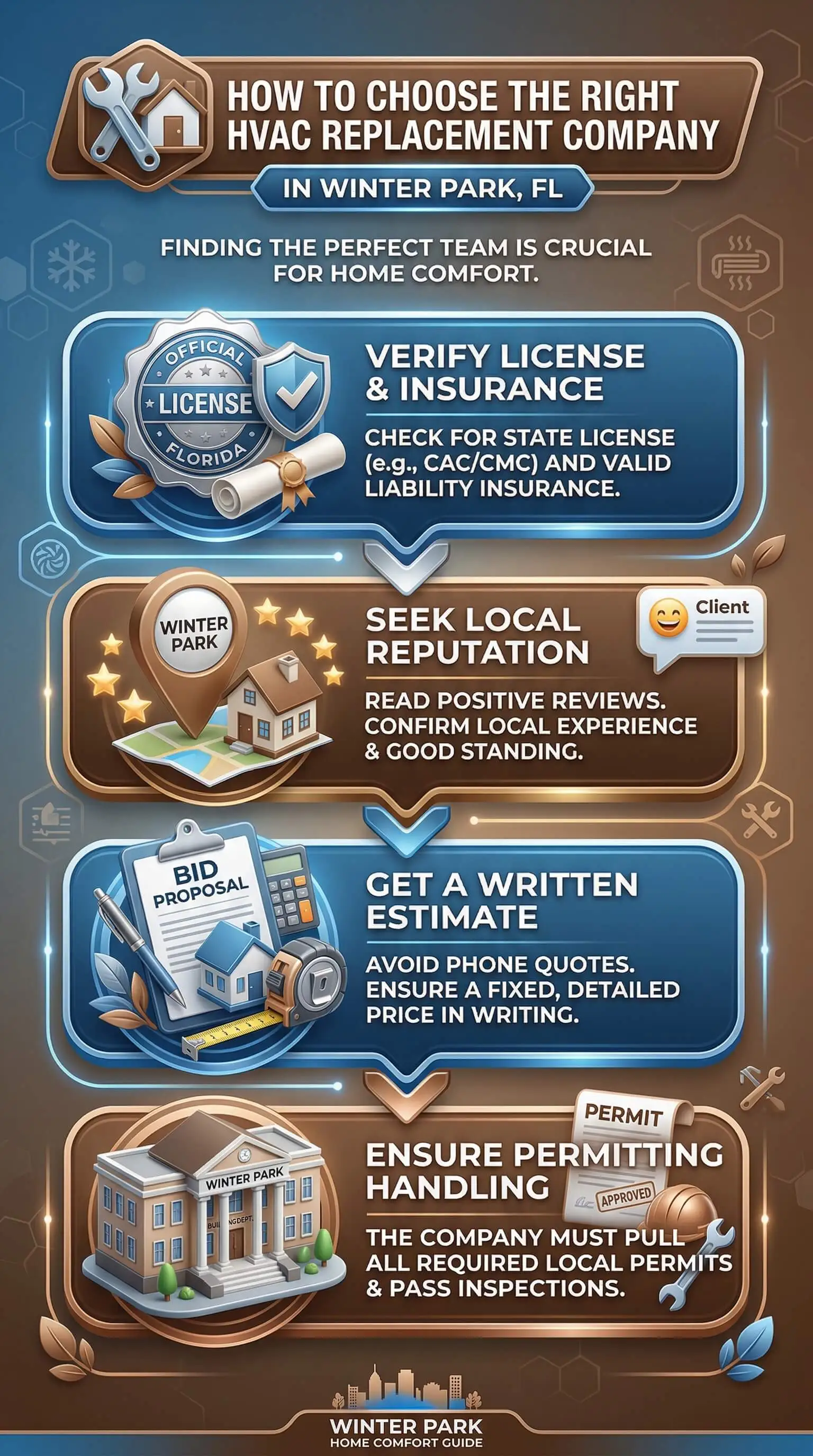
Every HVAC contractor working in Winter Park must hold a license through Florida’s Construction Industry Licensing Board: a Certified Class-A or Class-B Air Conditioning Contractor credential. State-level requirement. Not a local preference. Before you agree to anything, ask for the license number and look it up. Thirty seconds on the state database tells you whether you’re dealing with a legitimate, legally authorized business.
Licensing gets you past the legal minimum, but NATE certification goes considerably further. North American Technician Excellence is the most recognized independent credentialing body in the HVAC industry, and technicians who hold it have passed real working-knowledge exams in installation, service, and system performance. We’ve consistently found that contractors employing NATE-certified technicians have fewer callbacks and fewer early failures. The work gets done correctly the first time, which means you’re not spending the following summer trying to figure out why the system isn’t performing.
Proper System Sizing for Winter Park Homes
Oversizing is where most replacements quietly fail — and it usually stays invisible until the August electricity bill arrives.
An oversized system short-cycles. It brings the temperature down fast, shuts off, and kicks back on before the air has had time to pull moisture out of the room. Central Florida humidity regularly sits above 70 percent in summer. A system that can’t manage moisture doesn’t just make a home uncomfortable; it creates the conditions mold needs to grow and lets indoor air quality degrade over months. An undersized system has the opposite problem: it runs all day, still falls short on the worst afternoons, and drives your Duke Energy bill higher while delivering less comfort.
Correct sizing requires a Manual J load calculation. That means accounting for your specific home: square footage, ceiling height, insulation quality, window area, orientation, and local Orange County climate data. Any contractor who quotes you a tonnage without walking your home first is working from a guess. You’ll pay for that guess for as long as the system runs.
Duct Condition and Air Sealing
A new system connected to deteriorating ductwork is a half-finished job.
In neighborhoods like those around Lake Maitland, many homes built in the 1970s and 1980s still have their original duct systems: return grilles too small for modern equipment, attic runs without insulation, and connections that have been slowly leaking conditioned air into a hot attic for years. You can install the most efficient unit on the market, and it won’t matter much if a significant portion of what it produces never reaches the rooms you’re trying to cool.
Ask every contractor whether ductwork evaluation is part of the assessment scope. If the answer is no, ask why. Get that answer in writing.
How to Compare HVAC Replacement Quotes in Winter Park FL
Multiple quotes are good practice. Knowing what you’re actually comparing is what protects you.
Price pulls the eye first, but it’s the least useful number when you’re evaluating proposals. Two quotes at a similar dollar amount can represent entirely different scopes of work. The lower one might use a less efficient system, skip the duct inspection, leave permit fees out of the total, or back the labor with a 90-day warranty instead of two years.
Compare every proposal on these five points:
System make, model, and SEER2 efficiency rating, not just tonnage. SEER2 is Florida’s current standard and affects your monthly bill and your eligibility for utility rebates.
Full labor scope in writing: removal of old equipment, installation, refrigerant charge, startup testing, and whether duct inspection is part of the job or a separate line item.
Permit inclusion. Orange County requires a permit for HVAC replacement, and a licensed contractor pulls it. If a quote doesn’t mention permits, ask directly. Unpermitted work creates real complications at resale and can affect your homeowner’s insurance.
Warranty terms, separated. Equipment warranty and labor warranty are different documents, and neither replaces the other. Ask for both before you sign.
Post-installation commitment: whether the company schedules a follow-up visit, a startup check, or offers a maintenance plan. Contractors who stand behind their work tend to say so upfront.
Understanding HVAC Warranties and Service Quality
What the manufacturer covers and what the contractor covers are very different things, and plenty of homeowners only discover the difference when they try to make a claim.
The manufacturer covers parts — typically 5 to 10 years depending on the brand and whether you registered the equipment after installation. That warranty doesn’t pay a technician to show up, diagnose the failure, or perform the repair. The contractor’s labor warranty covers the installation work itself. Among reputable providers in this market, one to three years of labor is standard. Some offer more. Ask for the document, not the verbal assurance.
Florida’s climate is worth factoring in here. A system running twelve months a year accumulates wear that systems in northern states don’t see for years. A contractor willing to back their installation with a meaningful written labor warranty is signaling something real about the quality of the job.
A maintenance plan from your installing contractor is worth evaluating as a practical protection decision, not a sales pitch. Annual service keeps the equipment running efficiently, preserves warranty coverage on most equipment brands, and catches refrigerant issues or electrical problems before they turn into expensive failures.
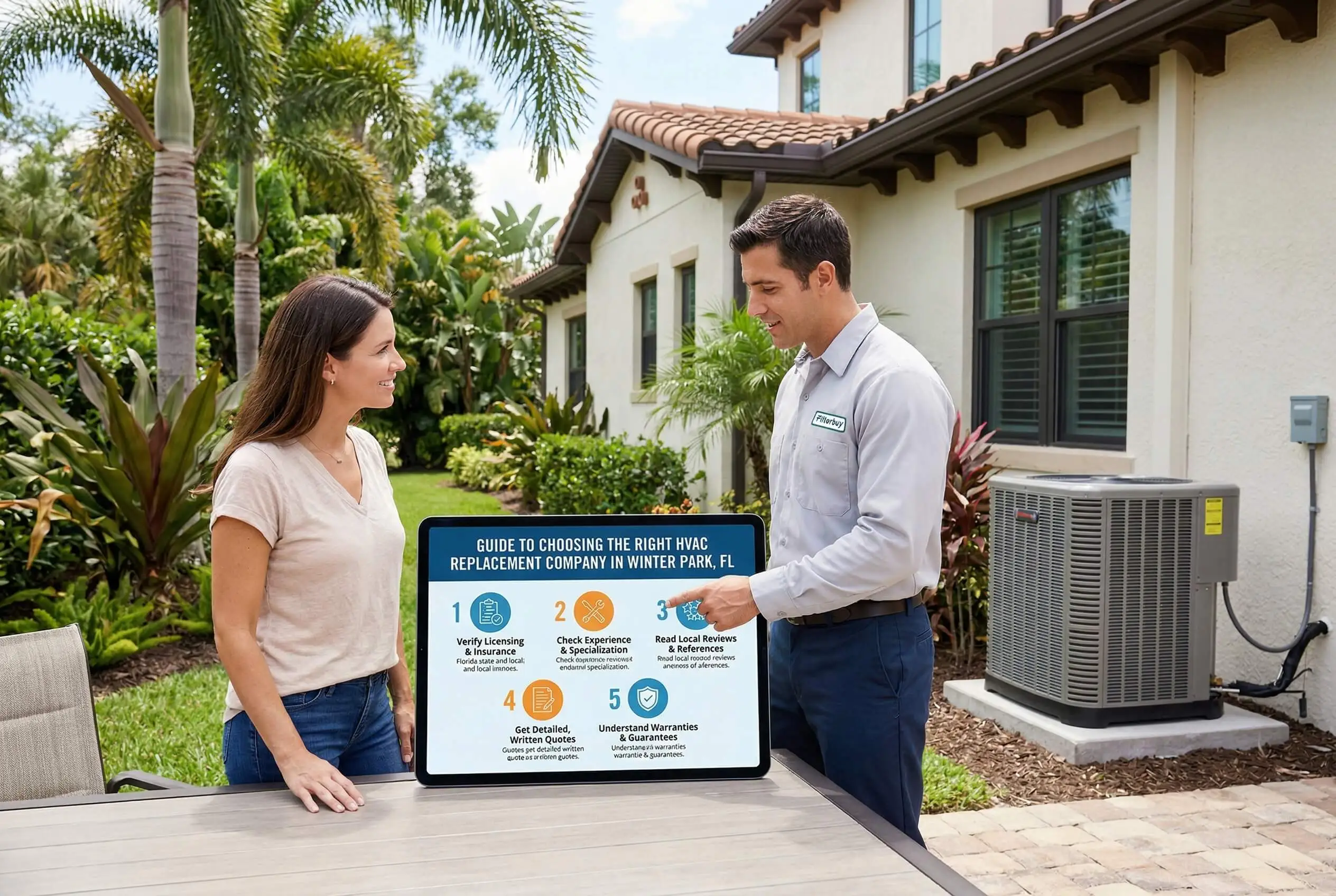
“Most homeowners I talk to in Winter Park assume a new unit solves everything. But I’ve walked into homes where a perfectly good system was installed over 1980s ductwork with return grilles that were never sized for it. The equipment works twice as hard as it should, the bedrooms still won’t cool evenly, and nobody told them the ductwork was the actual problem. After manufacturing filters and serving homes for over a decade, what we keep seeing is this: the box matters far less than the installation around it.”
Essential Resources
How to Find and Hire a Qualified HVAC Contractor
ENERGY STAR outlines what every homeowner should ask a contractor before signing: duct sealing standards, Manual J requirements, and what a quality installation actually involves. Worth reviewing before you request your first quote.
Source: https://www.energystar.gov/saveathome/heating-cooling
Why NATE Certification Matters for Your Replacement
The NATE FAQ page explains what the certification means, how to ask for certified technicians by name, and why contractors with NATE-certified staff consistently produce better outcomes on the first install. Plain language throughout.
Source: https://natex.org/homeowner/faqs
Find a Contractor with NATE-Certified Technicians Near You
NATE’s contractor locator lets you search by ZIP code for local HVAC businesses employing certified technicians. A practical first filter before you make any calls in the Winter Park area.
Source: https://natex.org/homeowner/find-a-contractor-with-nate-certified-technicians/find-a-contractor-with-nate-certified-technicians
Verify Your Florida HVAC Contractor’s License Before Work Begins
Florida’s DBPR maintains a live license search. Enter a contractor’s name or license number to confirm their CILB credential is active. The check takes less than a minute and removes the guesswork entirely.
Source: https://www2.myfloridalicense.com/how-to-verify-a-license/
Understanding HVAC Load Calculations and Why Tonnage Isn’t a Guess
The Department of Energy’s Manual J overview explains how accurate load calculations work and why sizing based on square footage alone consistently produces underperforming systems. Useful background before you talk to any contractor about system size.
Source: https://www.energy.gov/eere/buildings/downloads/hvac-right-sizing-part-1-calculating-loads
What Proper HVAC System Sizing Actually Looks Like
The Building Science Education Solution Center breaks down the real factors behind a proper load calculation in terms homeowners can use when evaluating contractor proposals and asking sharper follow-up questions.
Source: https://bsesc.energy.gov/energy-basics/hvac-proper-sizing-hvac-systems
ENERGY STAR’s HVAC Quality Installation Checklist
ENERGY STAR’s Quality Installation guidelines show what a properly executed replacement looks like at every stage. Reviewing this before any work starts gives you a clear framework for what to ask and what to confirm in writing.
Source: https://www.energystar.gov/sites/default/files/asset/document/HVAC_QI_bidsheet.pdf
Supporting Statistics
52% of a U.S. household’s annual energy consumption goes to space heating and air conditioning. HVAC is, by a wide margin, the largest energy expense in the average home — which is precisely why installation quality matters as much as the efficiency rating stamped on the equipment.
Source: https://www.eia.gov/energyexplained/use-of-energy/homes.php
28% of total household energy use in Florida goes to air conditioning alone — the highest share of any state in the country. Central Florida systems don’t get a seasonal rest. That’s the reality shaping every decision you make about who installs your replacement and how carefully they do it.
Source: https://www.eia.gov/pressroom/releases/press535.php
Up to 30% of system efficiency can be lost through improper installation, regardless of what the efficiency label says. A high-SEER2 unit installed incorrectly performs like a budget model. What the brand says on the equipment matters far less than the work that puts it in your home.
Source: https://www.energystar.gov/products/energy_star_home_upgrade/clean_heating_cooling
Final Thoughts and Opinion
Honest opinion, since that’s what this page is for.
We’ve served more than two million households and manufactured air quality products for over a decade. In that time, the problem we’ve seen most often isn’t bad equipment. It’s good equipment installed by a contractor who skipped steps: no load calculation, no duct evaluation, a warranty document that held up to nothing when tested.
Homeowners come to us after a replacement that didn’t fix what they paid to fix. They’re dealing with the same uneven rooms, the same humidity problem, and bills that didn’t come down. In nearly every case, the unit was fine. The installation wasn’t.
Winter Park homeowners pay attention. When something isn’t right, they know. The purpose of this page is simple: give you enough to evaluate a contractor honestly before you commit, rather than after the equipment is in the wall and the invoice is paid.
Our honest read: the best HVAC replacement you can get isn’t the cheapest quote or the most familiar brand name. It’s the contractor who walks your home, runs the numbers, explains the work in plain terms, includes ductwork in the scope, and backs everything with documentation you can actually read. That’s what a trustworthy installation looks like. It’s what we hold ourselves to on every job.
Frequently Asked Questions
Q: How do I find the top HVAC system replacement near Winter Park FL?
A: Start with credentials, not price.
Look for Florida-licensed contractors with a CILB-issued air conditioning credential, verified on the state database before any contract is signed.
Ask for NATE-certified technicians specifically and request credentials before work begins.
Confirm they perform a Manual J load calculation — not a square footage estimate — before recommending a system size.
Compare written quotes that itemize system specs, full labor scope, permit status, and both warranty documents.
Q: How much does HVAC replacement cost in Winter Park FL?
A: Most Winter Park homeowners spend between $5,000 and $12,000 for a full system replacement.
Cost varies based on system type, SEER2 efficiency rating, home size, and installation complexity.
Duct repair or sealing, when needed, is typically a separate line item — ask about it specifically before comparing totals.
A higher-efficiency system costs more upfront and saves meaningfully on energy bills in Florida’s year-round cooling climate.
Get an itemized written quote. It protects you from post-installation surprises.
Q: What size HVAC system do I need for my Winter Park home?
A: The only accurate answer comes from a Manual J load calculation.
Relevant factors: insulation levels, ceiling height, window area, home orientation, and local Orange County climate data.
An oversized system short-cycles and fails to control humidity — a real problem in Central Florida’s summers.
An undersized system runs continuously and still falls short on the worst afternoons.
If a contractor quotes a size without walking your home first, ask why. That’s a meaningful signal about how they work.
Q: What warranties should I expect with HVAC replacement in Florida?
A: Two separate documents. Both should be in your hands before you sign.
Manufacturer equipment warranties typically cover parts for 5 to 10 years, depending on the brand and registration.
A contractor’s labor warranty covers the installation itself — 1 to 3 years is typical among reputable providers.
Some manufacturer warranties require annual professional service to remain valid.
Verbal commitments aren’t warranties. Get both documents in writing.
Q: Does Filterbuy HVAC Solutions service Winter Park, FL?
A: Yes. We serve Winter Park and the greater Orlando area with HVAC system replacement services.
Our licensed technicians know what Central Florida’s climate demands from an installation.
We offer free consultations with no commitment to a scope until we’ve walked your home.
We size every system individually. We don’t quote tonnage from the driveway.
Q: How long does HVAC replacement take in a Winter Park home?
A: Most standard replacements wrap up in a single day.
Typical installation runs 4 to 8 hours for a standard residential system.
Homes requiring duct work, complex configurations, or permit inspections may take additional time.
We give you a realistic timeline during the consultation — before anything gets scheduled.
Ready to Choose the Right HVAC Replacement Company in Winter Park FL?
Choosing the right HVAC company means choosing someone you trust to do the job correctly — not just someone available when you’re under pressure. Reach out to Filterbuy HVAC Solutions for a no-pressure consultation and find out what a properly scoped, honestly quoted HVAC replacement looks like in Winter Park.
In How to Choose the Right HVAC Replacement Company in Winter Park FL, it is important to show that the best contractor does more than replace equipment—they also help homeowners choose the right filters to protect airflow, efficiency, and indoor air quality after installation. A trustworthy company should be able to explain when a 12x24x1 MERV 8 air filter, a 20x25x1 pleated HVAC air filter, or a 14x18x1 MERV 11 replacement filter is the best fit for a newly installed system, because a company that understands both HVAC replacement and proper filter compatibility is far more likely to deliver lasting comfort and long-term value for homeowners in Winter Park FL.