We've been at this long enough to know the answer almost never lives in the quote itself. It lives in your furnace's age, the type of motor the system uses, what your warranty actually covers, and what the rest of the unit is going to do next. A blower motor sits at the working heart of every forced-air central heating system, so the call to replace it pulls everything else into the conversation: your comfort, your energy bills, the air your family is breathing, and how many more winters your furnace has in it.
Here's how we'd think it through with a neighbor at the kitchen table.
TL;DR Quick Answers
blower motor replacement cost
A furnace blower motor replacement cost typically runs $300 to $900 in most homes, parts and labor combined. We see motor prices land between $50 and $450 depending on whether it's a PSC or ECM unit, with labor adding $150 to $400. After-hours service can add another $100 to $200.
Typical total cost: $300–$900 (parts and labor)
Motor only: $50–$450 (PSC runs cheaper, ECM higher)
Labor: $150–$400 (usually 1 to 2 hours of work)
What drives the price: motor type, access difficulty, added parts, restricted-airflow damage
Top Takeaways
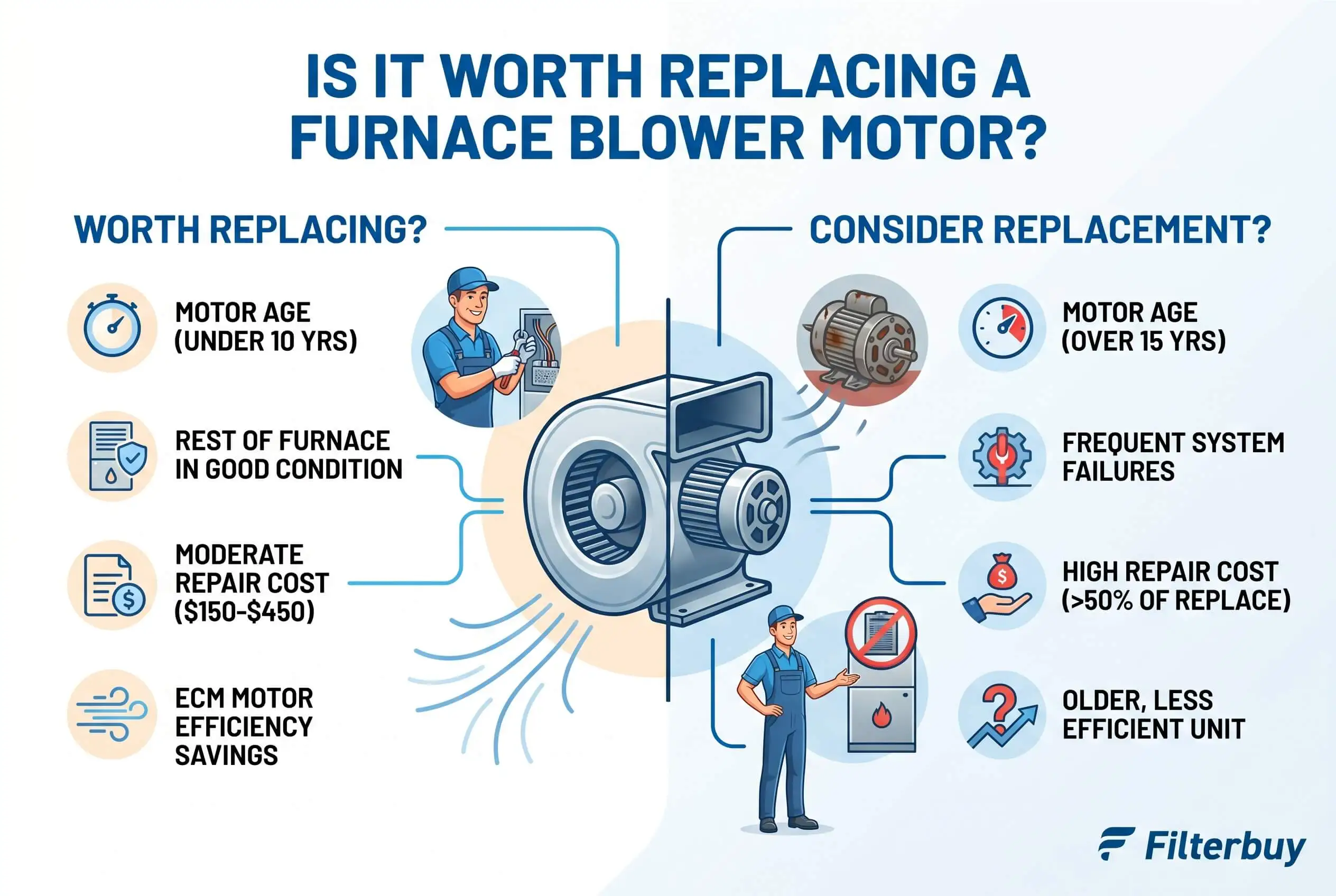
Repair is usually the right call when your furnace is under ten to twelve years old and the rest of the system is sound.
Motor type drives the cost more than any other single factor. PSC swaps run lower, ECM swaps run higher.
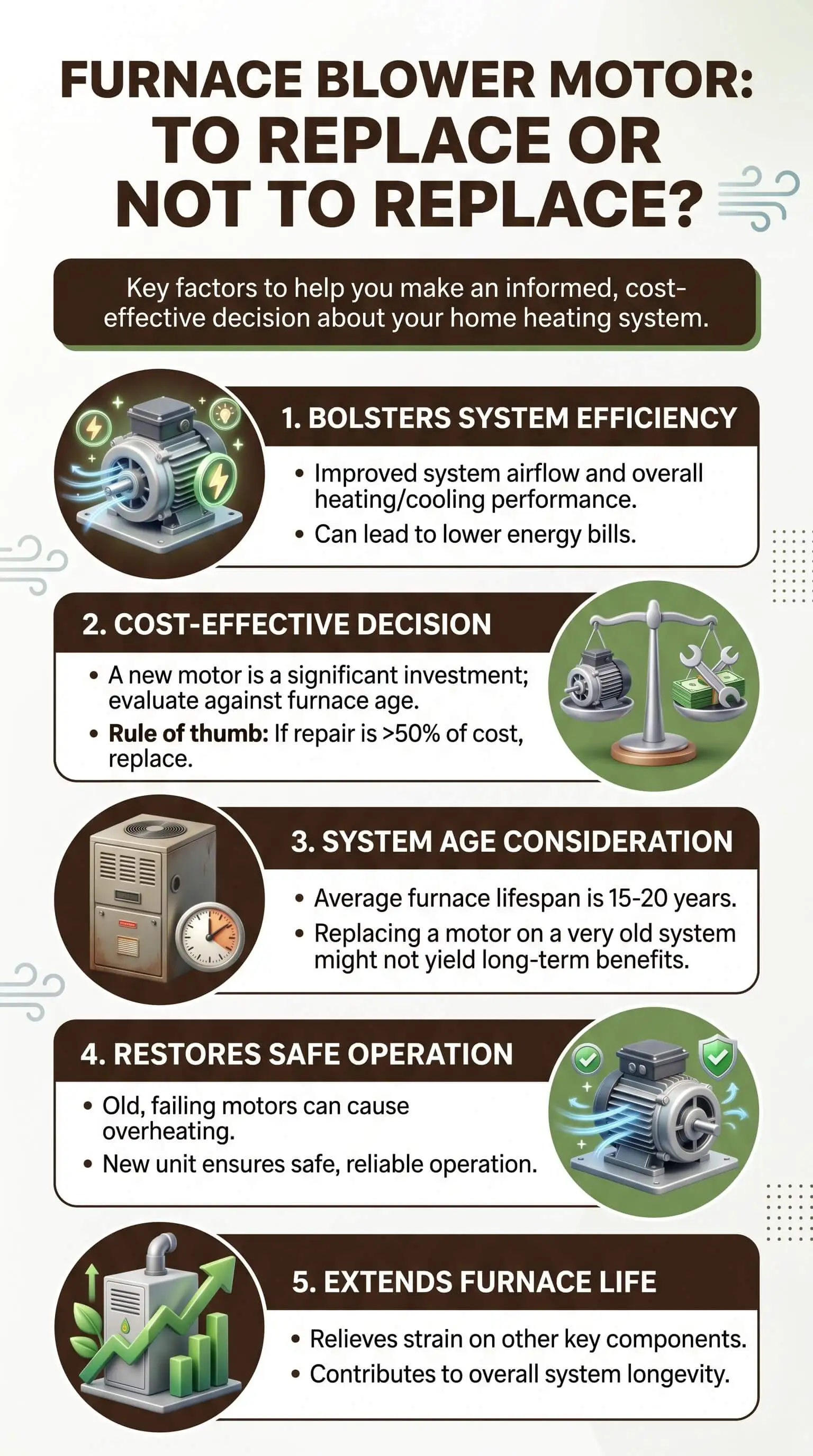
The 50% rule: when the repair quote approaches half the price of a new furnace, replacement starts winning the math.
Restricted airflow from a clogged filter is the most common silent killer of blower motors. Fixing what caused the failure matters more than swapping the part.
Manufacturer warranties often cover the part but not the labor. Ask before you approve any work.
When Replacing the Motor Makes Sense
Repair tends to be the right call when the furnace is under ten or twelve years old, the rest of the system runs clean, and there's no repair history piling up behind it. A single motor failure on an otherwise healthy unit is exactly what blower motors do: they're a wear part with a finite lifespan, and a clean swap puts the system back to full service.
hat goes double when the furnace is still under manufacturer parts warranty. We've found homeowners are sometimes surprised the part is covered, even though labor usually isn't. Ask before you approve any work, and review the types of furnace filters being used so airflow issues do not create another repair later.
When It Probably Isn't Worth It
The math shifts once the furnace crosses fifteen years and the symptoms stack up beyond a single motor failure. The rule of thumb we use on service calls is straightforward: when the repair quote approaches half the cost of a new furnace, replacement starts to win. The math gets even less friendly if the system has already eaten a recent igniter repair, the heat exchanger is tired, or the unit has been short-cycling for years from being oversized in the first place, which is why maximizing the lifespan of HVAC system starts with fixing small airflow and sizing issues before they become major repair decisions.
A blower motor on a sixteen-year-old furnace is almost never a single decision. It's the first bill of three or four you'll see over the next two years, and replacing the part doesn't change that trajectory.
PSC vs. ECM — The Biggest Cost Driver
The kind of motor your furnace uses changes the math more than any other single factor. PSC (permanent split capacitor) motors live in older and entry-level systems. They run at fixed speeds, usually pair with a separate capacitor, and sit at the lower end of the cost range. ECM (electronically commutated motor) units show up in newer high-efficiency furnaces. They vary their speed to hold airflow steady, and they almost always cost more to replace, especially when the motor and its control module ship as one assembly you can't pull apart.
Across the systems we see most often, the worth-it line tracks closely with motor type. A PSC swap on an aging furnace can feel painful next to the unit's remaining life. An ECM swap on a newer high-efficiency furnace usually pays for itself, because you're protecting a system with another decade ahead of it.
Climate matters too. In subtropical regions where the cooling season runs long, that same blower carries an outsized workload year-round. Take a Florida build with the furnace mounted up in the attic: summer attic temperatures push past 130°F, which compounds the wear that long AC seasons already put on the motor.
What's Really Driving the Quote
When the quote surprises you, four things are usually responsible. Motor type does most of the heavy lifting in the final number. Access matters next, since tight attic installs and packed mechanical closets stretch labor hours fast. Added parts can push the bill higher too, like a fresh capacitor on a PSC system or a control module on some ECM assemblies that ship as one piece. And there's almost always some collateral damage from restricted airflow to deal with. A clogged filter or a dirty blower wheel doesn't just kill the motor. It also adds cleanup time to the job once the cover is off.
If you want the deeper parts-versus-labor walkthrough that breaks the numbers down by motor type and warranty scenario, the detailed cost guide covering PSC and ECM differences is where to look.
"The quote that surprises homeowners almost never comes back to the motor itself. The motor is what broke, but the story started two heating seasons earlier and nobody slowed down to read it. When we walk into a job and find a return filter that hasn't been changed since the previous summer, we already know what we're looking at. That motor didn't fail on its own. The right repair starts with figuring out what killed the part, not just what to swap in for it."
7 Essential Resources
Every cost, lifespan, and efficiency claim in this article traces back to a primary government source. Here's where to check the numbers yourself.
U.S. Department of Energy — Furnaces and Boilers. AFUE efficiency ranges and the official federal guidance on retrofit-versus-replace decisions.
ENERGY STAR — Furnaces. Regional efficiency standards and projected annual energy savings for certified gas and oil furnaces.
ENERGY STAR — Furnaces Key Product Criteria. The technical definition of AFUE and the certification thresholds that separate baseline from high-efficiency units.
DOE Energy Saver — Minimizing Energy Losses in Ducts. How airflow restriction and duct leakage stress the blower motor and inflate heating bills.
EPA — Guide to Air Cleaners in the Home. Filter selection guidance and the airflow trade-offs that affect blower motor longevity.
DOE FEMP — Purchasing Energy-Efficient Residential Furnaces. Federal acquisition criteria and the BTU thresholds that distinguish residential from commercial units.
DOE Energy Saver — Gas-Fired Boilers and Furnaces. Fuel-specific retrofit guidance for the most common furnace type in U.S. homes.
Supporting Statistics
Older fossil-fuel furnaces typically run at 56% to 70% AFUE, while modern high-efficiency units reach 90% to 98.5% AFUE. The U.S. Department of Energy reports that moving from 56% to 90% efficiency can cut fuel bills roughly in half in cold-climate homes. (Source: DOE Energy Saver — Furnaces and Boilers.)
ENERGY STAR-certified gas furnaces in the northern U.S. are up to 15% more efficient than baseline models and save an average of $120 per year in energy costs. In the southern U.S., certified units run up to 11% more efficiently with average annual savings near $40. (Source: ENERGY STAR — Furnaces.)
Duct heat loss can run as high as 35% of furnace output when ductwork passes through attics, garages, or other unconditioned spaces. That's a hidden tax on every dollar your blower motor pumps. (Source: DOE Energy Saver — Furnaces and Boilers.)
Final Thoughts and Opinion
If we were standing in your mechanical room right now, here's what we'd want you to take home: the system around the motor is almost always the real question, not the motor itself. A clean swap on a young, healthy furnace with properly maintained furnace filters is straightforward and worth doing. A swap on a sixteen-year-old unit that's been limping along for a couple of winters is almost always good money chasing a problem that won't stay fixed.
If your furnace sits in the gray zone, somewhere between ten and fifteen years old, the worth-it call comes down to motor type, warranty status, and how much you trust the rest of the system. When in doubt, ask for the parts-and-labor breakdown in writing, then sit with it for an evening before you decide. The good repair is the one you won't second-guess six months from now.
Frequently Asked Questions
How long does a furnace blower motor last?
Most blower motors run fifteen to twenty years under normal conditions, which roughly matches the furnace's own lifespan. When they die early, the culprit is almost always restricted airflow, overheating, or a failing capacitor straining the motor windings.
Can I replace a furnace blower motor myself?
A handy homeowner can swap a motor on a basic PSC system, but we don't usually recommend it. A bad install can void warranties, create electrical hazards, and skip past the underlying problem that killed the original motor. The labor on a professional replacement covers diagnosis, safe disassembly, and airflow testing. Those steps matter.
How do I know if it's the blower motor or the capacitor?
On a PSC system, a weak capacitor can mimic motor failure. The motor hums but won't start, or it starts slow and overheats. A good technician tests the capacitor before condemning the motor. Replacing a $20 capacitor instead of a $400 motor is the easiest savings on the table when the diagnosis points that direction.
Is an ECM blower motor always better than a PSC?
Not always. ECM motors give you better airflow control and modest efficiency gains, but they cost more upfront, and the integrated control assemblies can be harder to service later. If your furnace is older and uses a PSC, replacing in kind is usually the right move. An ECM upgrade only earns its cost on a system already built to use variable-speed airflow.
Will replacing the blower motor lower my energy bills?
Modestly, if at all. The biggest efficiency gains come from the furnace's heat exchanger and burner, not the blower. An ECM motor on a system designed for one can trim some electrical use, but if you're actually trying to cut energy bills, a high-efficiency furnace upgrade does a lot more for the dollar.
Should I replace the whole furnace if the blower motor fails?
Only when the math says so. A sound furnace under twelve years old earns the repair. A tired furnace past fifteen years with other repairs already looming usually earns the replacement. Let total cost of ownership drive the decision, not just the size of the quote in front of you.
Decide With Confidence
A clear decision framework beats a panicked yes-or-no every time, and the right questions turn a confusing quote into a straightforward call. Walk into your next contractor conversation with the framework above, especially when comparing top HVAC replacement contractors, and the worth-it answer gets a lot easier to see.
In an article about Is It Worth Replacing a Furnace Blower Motor?, it’s helpful to connect the repair decision back to the airflow conditions that may have caused the motor to fail in the first place. A homeowner comparing the cost of a new blower motor can also review filter options like 20x30x1 furnace filters, 12x20x1 HVAC air filters, and 21x21x1 furnace filters, because the right filter size and MERV rating can help maintain cleaner airflow, reduce unnecessary strain on the blower assembly, and make the replacement more worthwhile over the long term.